

The tuition figure is only one line in a school budget. A family may be able to pay that amount and still struggle when uniforms, transport and the first week's supplies fall due together. Comparing private school fees in Lusaka works best when you calculate both the complete cost and the dates when money is needed.
Start with a written fee schedule for the correct year and class. Separate recurring charges from one-off entry costs, then add the expenses your household pays directly. Do not treat an optional activity as compulsory, or assume an unlisted service is included.
Build three lists before comparing schools
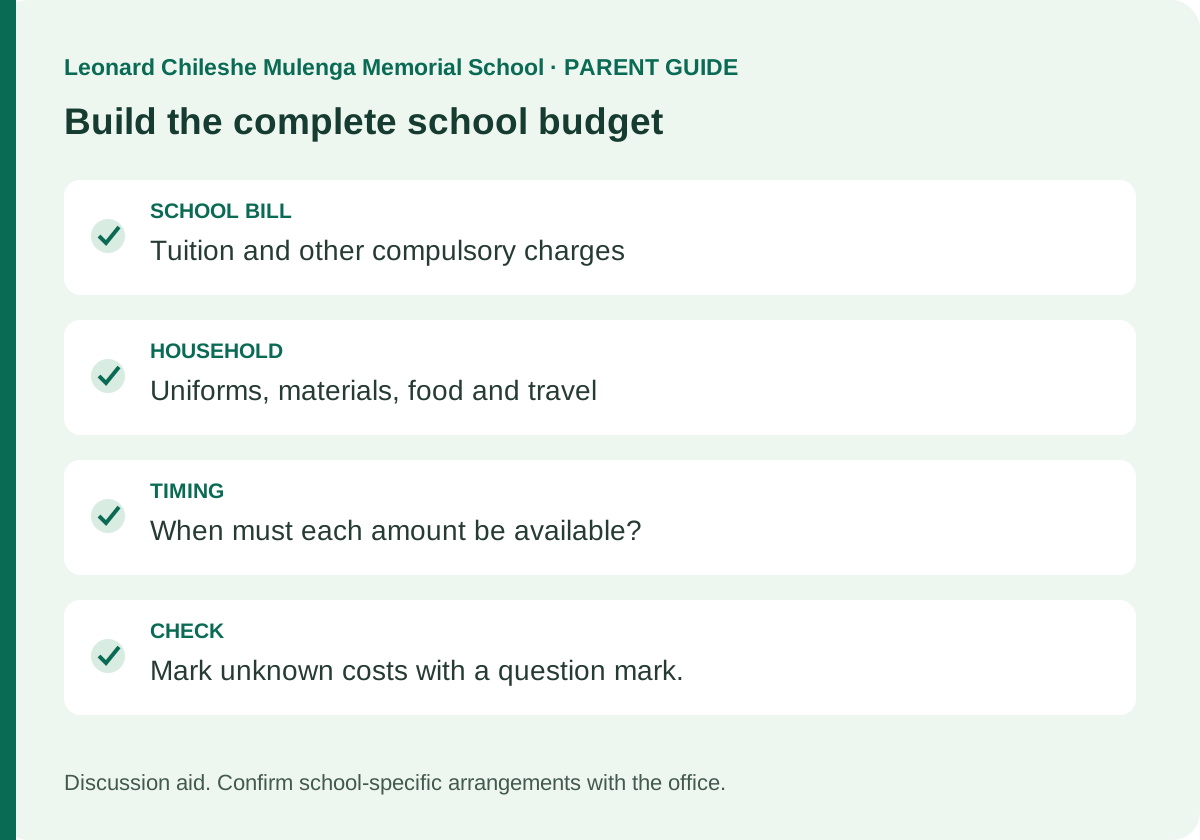
The first list is the school's compulsory bill: tuition and any required maintenance, PTA, registration or assessment charges. The second is essential household spending needed to attend, such as the required uniform and a workable transport arrangement. The third is optional spending you can choose after understanding the offer.
Ask whether each charge is per term, per year, once on entry or linked to a particular activity. A fee called “development” or “maintenance” is not automatically a once-off payment. Write the frequency beside the amount so that your annual estimate does not quietly omit later bills.
For example, two hypothetical schools might advertise the same tuition while one includes certain materials and the other charges separately. That does not immediately make one better value. Compare what is included, what your child needs and what you would otherwise purchase.
Use the current Leonard Chileshe Mulenga Memorial School schedule
The School Fees page, checked on 22 October 2026, lists 2026 tuition of K4,500 per term for Pre-School and K5,500 for Primary School. It also lists K1,000 maintenance and K1,000 PTA per term. These published categories total K6,500 for Pre-School or K7,500 for Primary before other applicable expenses.
These are 2026 figures, not a quotation for a later academic year. Request an up-to-date statement for your child before payment. The online application currently identifies a separate K200 application fee; confirm payment instructions through the official school channel.
The admission and fee policy explains payment timing, withdrawal and refund conditions. Read the actual terms rather than assuming you may pay monthly because you plan your household budget monthly. Saving each month and having an approved instalment agreement are different things.

Uniforms and materials are easier to plan early
Check the required items and whether the school specifies where to obtain them. Find out which sizes are available and whether a replacement or additional set can wait. Buying many items before confirming the class and uniform requirements can leave a family with unnecessary expenses.
Use the school-uniform information as your starting point for the school. Ask which learning supplies apply to your child's class. The published admissions policy distinguishes supplied stationery from items some classes bring, so avoid buying a general stationery list copied from another school.
Keep a small replacement allowance for lost or worn items, but do not describe that allowance as a school charge. Label belongings in the way the school recommends and check what comes home before purchasing duplicates.
Calculate transport and food separately
Transport costs depend on the arrangement your family actually uses. Consider both journeys, the number of school days and any additional trip needed for activities or collection changes. If another adult helps, agree the arrangement rather than assuming their availability.
Ask whether meals are provided, optional or brought from home. This guide does not confirm a meal or transport service at the school. Obtain that information directly before adding a service to your plan. If food is prepared at home, estimate the extra household expense without counting costs twice.
An illustrative household might choose a school with slightly higher tuition because its confirmed collection arrangements fit the family's working hours. Another might find a lower tuition bill is outweighed by extra travel. The useful comparison is the total workable plan, not a single headline number.
A worksheet you can copy
| Budget line | Amount in ZMW | Frequency or due date | Confirmed with whom? |
|---|---|---|---|
| Tuition | Fill in | Each term | School office |
| Other compulsory school charges | Fill in | Check each item | School office |
| Application or entry charges | Fill in | Usually linked to application or admission; verify | Admissions |
| Required uniform and shoes | Fill in | Initial purchase and replacements | Official uniform list |
| Required books and materials | Fill in | Confirm by class | Teacher or office |
| Transport | Fill in | Your actual arrangement | Provider or family |
| Food | Fill in | Your actual arrangement | School and household |
| Optional activities | Fill in | Only if chosen | School office |
| Household contingency | Fill in | Your own allowance | Family decision |
This blank worksheet is a planning tool, not a school invoice. Put a question mark beside an unconfirmed item instead of entering zero. Zero means the expense is confirmed as absent; an unanswered question means the budget is incomplete.
Work backwards from payment day
Add the costs due before the term, subtract money already set aside, and divide the balance by the number of saving periods remaining. For illustration only, a household target of K9,000 with K3,000 already saved leaves K6,000. Across three remaining months, that means K2,000 per month. These amounts are not school fees or an instalment offer.
Then check the timing. If uniforms must be purchased earlier than tuition, part of the savings must be available earlier too. Keep payment confirmations and note the child's name and the term covered. Verify current bank details with the school before transferring money.
Questions that prevent surprises
- Which charges are compulsory and which are optional?
- Does this schedule apply to the intended year and class?
- What is the exact payment deadline?
- Are any instalment arrangements available, and can the terms be provided in writing?
- What changes if a child joins during a term?
- What notice is required before withdrawal, and which fees are non-refundable?
- Which materials and activities are already included?
Do not rely on another parent's past discount or payment arrangement. Ask for the terms that apply to your application. If the complete budget is uncomfortable, resolve the gap before committing rather than assuming an exception will be granted later.
Compare costs alongside our primary-school selection questions. When you are ready, the application preparation guide explains what to organise next. For a current quotation, return to the official fees page and contact the school office.
Back to All Articles