

The morning journey may fit neatly into a parent's trip to work while the afternoon collection does not fit at all. That is why choosing a school when you live in Chilanga and work in Lusaka requires more than measuring the distance from home.
Compare a complete weekday: leaving home, handing over your child, reaching work, collecting on time and getting home. Then test what happens when the usual adult is unavailable. The school must suit your child educationally and the routine must be workable for the adults responsible for care.
Start with confirmed times
Ask each school for the actual start and collection times for the class you are considering. Check whether they vary on particular days or when activities take place. General office hours do not establish when a child can be dropped off or how long they may remain supervised.
Ask explicitly about supervision before lessons and after the normal collection time. Find out whether any additional arrangement exists, who is responsible and whether it costs extra. If the answer is not confirmed, do not build it into your work schedule.
Leonard Chileshe Mulenga Memorial School is in Makeni, Lusaka, not Chilanga. Its location may be relevant to some commuting families, but suitability depends on your own route and timetable. This article does not confirm a school transport service or extended supervision at the school.
Test the journey at the relevant time
A weekend drive can help you locate the school, but it cannot establish the time needed on a school morning. Where practical, test the route near the times your family would travel. Record the complete journey rather than only the driving portion.
Include getting children ready to leave the vehicle, walking to the approved handover point and continuing to work. Consider the route used by the actual collector in the afternoon. Avoid relying on a single unusually quick trip or a map's best-case estimate.
For example, imagine a parent whose workplace is conveniently beyond the school on the morning route. If that parent's working day ends after collection, the convenient morning does not solve the afternoon. The family needs a confirmed alternative before enrolling.
Check the arrangement when the usual plan fails
Identify an adult who is willing and able to collect if necessary. Confirm their availability, transport and contact details. Then ask the school how that person must be authorised and what identification or notification is required.
A second example is a family where a grandparent collects twice a week. The arrangement needs more than a verbal understanding at home. The school needs the correct authorisation, and the grandparent needs the confirmed time and entrance instructions. Agree who contacts the school if the plan changes.
Ask how the school communicates an urgent issue during the day. Provide usable contact details and a backup number where required. Do not assume an adult who can collect at the end of the day can necessarily leave work for an earlier call.

Consider the child's experience of the routine
Think about waking time, the journey, meals, opportunities to rest and time at home. A route that adults can technically manage may still be tiring for a young child. Look at the pattern across a week rather than treating each trip as an isolated event.
If several children attend different schools, write down both timetables. Check whether handover and collection can be completed safely without one child waiting in an unconfirmed arrangement. Avoid solving a scheduling conflict by assuming the school will make an exception.
Compare travel costs with the whole school budget
Estimate the cost of the actual arrangement, including both directions and any extra journeys. If a transport provider is involved, check the terms, responsibility for handover and what happens when the vehicle or driver is unavailable. Verify suitability and safety directly before committing.
Use the school-fee budgeting guide to compare total expenses. A shorter journey does not automatically make a school affordable, and lower tuition does not automatically make a distant school cheaper overall.
| Part of the day | What to confirm | Backup question |
|---|---|---|
| Arrival | Class reporting time and approved handover point | What if the usual driver is unavailable? |
| During lessons | How urgent contact reaches a guardian | Who can respond if the first number is unanswered? |
| Collection | Exact time and authorised collector procedure | Who can collect if work runs late? |
| Activity days | Any different finishing time | Can the same adult still manage the journey? |
| Travel costs | Actual recurring and occasional expenses | Is there room for an unexpected extra trip? |
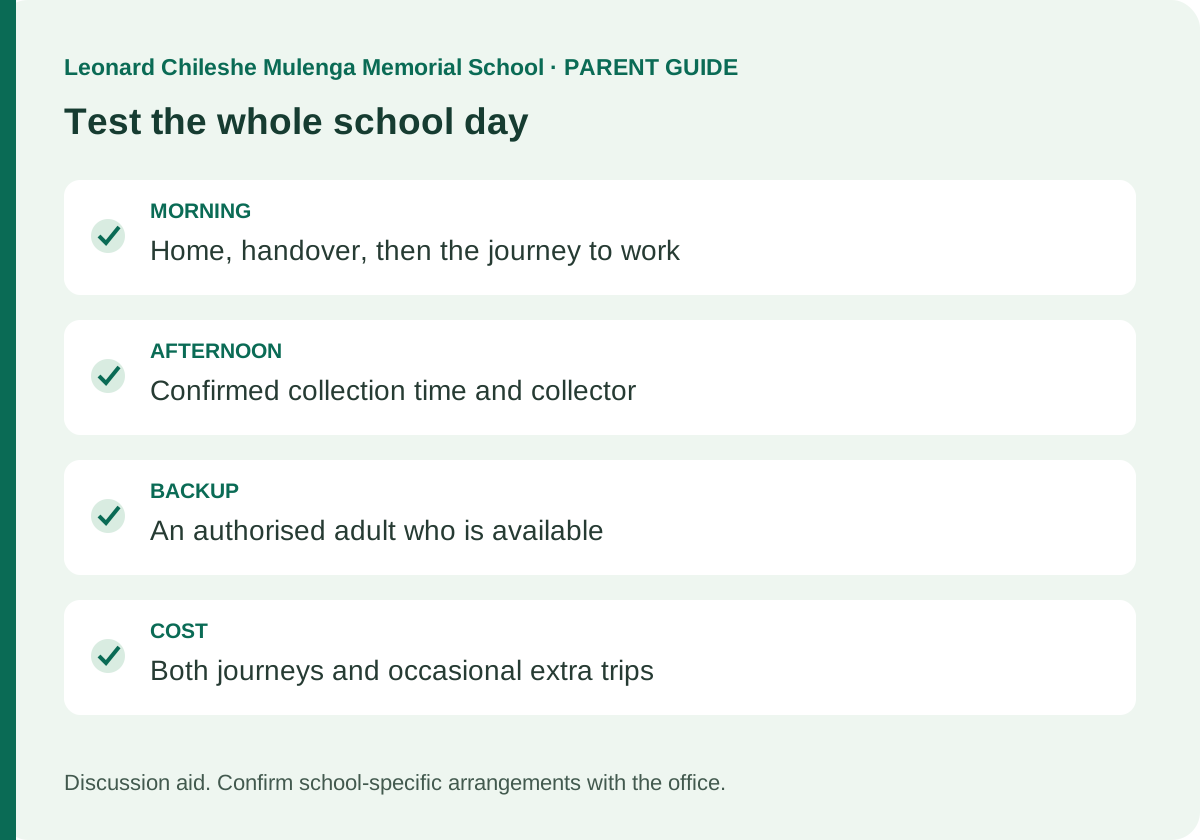
Use the visit to resolve practical uncertainties
Read the school visit guide and arrange a suitable appointment through the Contact page. Ask about the arrangements that matter to your household without assuming services shown on another school's website apply here.
Keep educational fit in the conversation too. Our primary-school selection guide covers teaching, progress and support. A convenient route is valuable, but it should sit alongside those questions.
Can I use the office opening time as the earliest drop-off time? No. Obtain the class-specific handover and supervision arrangements directly.
Does being near my work make a school the best option? It may help, but compare the afternoon journey, the child's needs and the backup plan as well.
How much extra journey time should we allow? There is no reliable universal figure. Use your own observations and build a realistic margin without treating it as a guarantee.
Before making the final decision, write the agreed weekday plan in a form every responsible adult understands. If a key part still depends on an unconfirmed service or an unavailable collector, resolve that gap first.
Back to All Articles