“My child knows the alphabet. Should we skip Middle Class?” A class name cannot answer that question. Baby Class, Middle Class and Reception describe stages used by many schools, but placement also depends on the school's programme and the child's experience, communication and support needs.
At Leonard Chileshe Mulenga Memorial School, these are the three published Pre-School classes, with Grade 1 following Reception. The descriptions below explain common learning emphases. They are not a timetable, assessment policy or set of fixed age bands for every Zambian school.
Three stages, increasing familiarity
Baby Class often introduces children to spending time in a group away from home. Familiar routines, songs, conversation, movement and simple play give adults opportunities to help children participate. Learning to ask for help may matter more than producing a neat page of writing.
Middle Class commonly builds on that experience. Children may spend more time talking about stories, sorting objects, taking turns and completing short activities. Adults can gradually encourage greater independence while continuing to provide reassurance and practical help.
Reception usually prepares children for the transition towards primary school. That can include more sustained listening, early sound and print awareness, counting real objects and managing familiar classroom routines. It should not be understood as a demand that every child already reads independently.
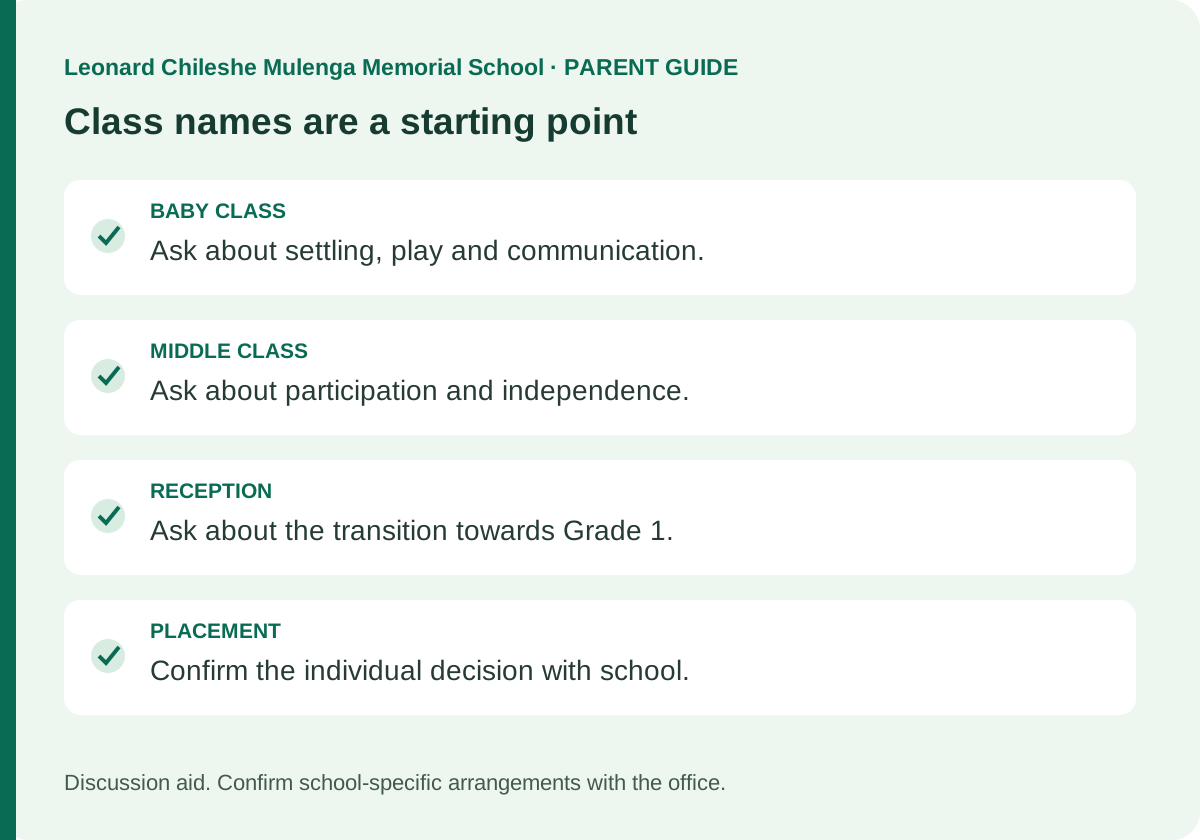
| Class | Typical emphasis to ask about | A useful question for the teacher |
|---|---|---|
| Baby Class | Settling, communication, play and simple routines | How do you help a child tell you what they need? |
| Middle Class | Participation, language and increasing independence | How do you build on what each child can already do? |
| Reception | Consolidating early learning and preparing for Grade 1 | How do you review progress and discuss the next stage? |
The table is a discussion aid, not the school’s official curriculum. Confirm the actual learning programme through the Pre-School information page and a conversation with the school.
What progression looks like in ordinary activities
Consider a pretend shop. A younger child might name a banana and hand it to an adult. Another might ask for two items, wait for a turn and explain what they are buying. A more experienced child might make a picture list, count the items and discuss which basket has more. The same materials can support different levels of learning.
Story time offers another example. One child points to a picture; another explains what a character is doing; another suggests what might happen next. These are illustrative activities, not accounts of lessons observed at the school. They show why a class decision should consider more than reciting memorised words.
Language develops through listening and being heard. Tell the teacher which languages your child uses confidently at home. Ask how classroom instructions are explained and how staff distinguish unfamiliarity with the teaching language from difficulty understanding a task.

Early reading and numbers without pressure
Sharing books can include naming pictures, retelling a familiar event and noticing print. Drawing, handling suitable crayons and making marks can help children explore how ideas are recorded. Ask how the school introduces these experiences and how it responds when a child needs more practice.
For number awareness, count actual objects together rather than only repeating a sequence. Putting one cup beside each plate helps a child connect a number with a quantity. Sorting clean socks by size or colour creates opportunities to describe similarities and differences. Use age-appropriate materials and supervise young children.
Avoid making every enjoyable activity into a test. If a child has had enough, stop and return later. Their response on a tired afternoon is not a reliable basis for deciding which school class they belong in.
Independence includes knowing when to ask
Opening a bag, putting away a book and recognising one's belongings can make routines easier. So can telling an adult, “I need help.” Independence does not mean refusing assistance to children who need it.
Ask about toilet support, eating arrangements and transitions between activities. If your child has a disability or a particular support need, discuss the arrangements required in concrete terms. Confirm what the school can provide instead of relying on a general promise that the child will manage.
Questions before accepting a placement
- What information do you use to recommend a class?
- Which parts of the day would be familiar or new for my child?
- How will you communicate progress and any concerns?
- How do you support children with different language backgrounds?
- What happens if the initial placement needs review?
- Which criteria and conversations inform movement to the next class?
The school publishes a Nursery Section minimum of two years by the beginning of the academic year. That does not establish separate Baby Class, Middle Class and Reception age bands. Ask the school to confirm placement for your child's date of birth and circumstances. The admission process is the authoritative starting point.
Common questions
Are Reception and Pre-Grade always the same? Schools use different names and programmes. Compare the learning offered and the class that follows, rather than treating names as interchangeable.
Does knowing letters mean a child should move ahead? It is useful information, but listening, communication, participation and support needs also deserve discussion. Ask for a balanced assessment.
What if my child has never attended preschool? Explain that when enquiring. The school needs to consider experience and available support; a parent should not assign a class solely from an online comparison.
Use the preschool visit checklist to evaluate the environment, then read the Grade 1 readiness guide when planning the next transition.
Back to All Articles