

A new address can make a school transfer necessary even when a child is happy where they are. Sometimes the reason is a learning concern, a change in family finances or a journey that no longer works. Before withdrawing your child, establish what the new school can offer and what must happen for a place to be confirmed.
For families transferring primary school in Lusaka, organise three things together: the admission decision, continuity of learning and the child's adjustment. A completed form addresses only part of the move.
Clarify what the change needs to solve
Write down the main reason for considering a transfer. If it is a concern about teaching or care, record the specific issue and what has already been discussed. Where appropriate, speak with the current school before assuming a change will resolve it. If there is an immediate safety concern, prioritise the child's safety and seek appropriate help.
Use the reason for moving to guide your questions at the new school. A family looking for learning support needs a concrete discussion about that support. A family moving because of collection difficulties needs confirmed class hours and a reliable travel plan.
The primary-school comparison guide can help you compare responses without relying on reputation alone. Avoid telling a child that a new school will solve every problem; some adjustments will still take time.
Confirm a place before treating the move as settled
Ask which class has availability, how placement is decided and when the school will communicate its decision. An enquiry, a fee payment or an interview is not necessarily an offer. Check what acceptance requires and when the proposed starting date becomes firm.
For Leonard Chileshe Mulenga Memorial School, read the published admission process. It states that placement depends on availability, school readiness and assessment. It also requests previous school reports where applicable. Do not assume there is a separate transfer rule or guaranteed mid-term admission beyond what the school confirms.
Review the old school's withdrawal terms separately. Ask about notice, outstanding obligations and how records are obtained. Different schools may use different processes, so do not apply the new school’s terms to the school your child is leaving.
Prepare useful records, not a pile of unrelated papers
Ask the receiving school for its actual checklist. Commonly useful records include recent reports, information about subjects covered and details of support that has helped. Identification and application documents should follow the receiving school's requirements.
Keep originals safe and provide copies in the requested format. If a record is delayed, explain the situation and ask what alternative is acceptable. Do not alter a report or guess a missing result. Share sensitive information through an agreed private channel rather than a public parent group.
Our application guide separates the school's published requirements from general preparation advice. Confirm whether additional transfer documents are needed for your child's circumstances.
Protect continuity of learning
Ask how the new teacher will identify what your child has already studied. Class names or grade numbers do not guarantee identical sequencing of topics, textbooks or teaching languages. A short discussion can prevent unfamiliar material being mistaken for a lack of ability.
For example, a hypothetical pupil transfers after learning one method of subtraction. The new class uses another. Sharing recent work can help the teacher distinguish a difference in method from a misunderstanding of number. The answer is not automatically more homework.
In another example, a child is moving into a class using an unfamiliar teaching language. Tell the teacher what the child understands and expresses confidently at home. Agree how instructions and early participation will be supported, without assuming a particular service is available.
Let the child have questions
Explain what is known and what is still being decided. A child may worry about friends, finding the toilets or understanding the timetable rather than the issues adults are discussing. Ask what they would like to know and write down those questions for the visit.
Where possible and appropriate, help the child say goodbye to familiar people. Arrange contact with old friends if families wish and circumstances allow. Do not pressure them to describe the new school as better before they have experienced it.
Ask the receiving teacher how a new pupil is introduced to routines and classmates. A named adult to approach can be more helpful than a broad instruction to “make friends”. Confirm what the school actually does rather than promising a buddy arrangement that has not been agreed.
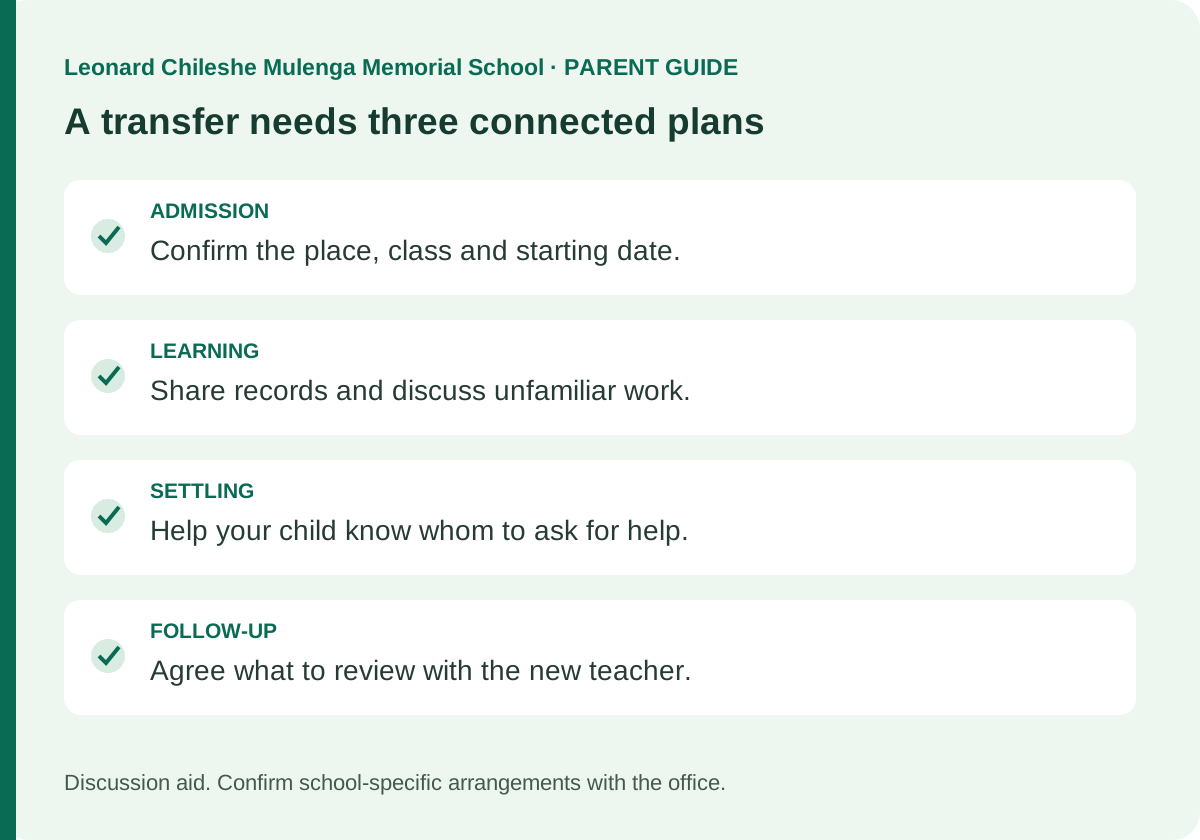
Transfer checklist
- Confirm the new school's decision, class and starting date.
- Review withdrawal and notice requirements at the current school.
- Request records early and check what the new school needs.
- Share learning and care information through the agreed channel.
- Compare topics, materials and teaching-language expectations.
- Confirm uniform, fees, supplies and collection arrangements.
- Explain the transition to the child in manageable steps.
- Arrange an early follow-up with the new teacher.
Review the first term with evidence
Ask what your child is managing and where they need help. Keep observations specific: difficulty finding a classroom, confusion about homework or reluctance to join a game. Avoid interpreting one difficult day as proof that the transfer was a mistake.
If a concern persists, agree an action and a review date. A change of school does not remove the need for an ongoing relationship with teachers. Check that home contact details and authorised collectors are correct after the move.
Can a child transfer during a term? Ask the receiving school about availability and the effect on learning and fees. There is no universal promise in this guide.
Should we buy uniforms before acceptance? Confirm the place and exact requirements first, unless the school gives a clear reason to do otherwise.
Who can clarify a school transfer? Contact the school office with the child's current grade, intended starting period and the questions you need answered before withdrawing.
Back to All Articles